

SenseHub® Dairy collars deliver for Waikato sharemilkers
July 8, 2026
Sharemilkers
Nic and Clare Coppard
Location
Matamata
Waikato
Farm Size
206ha
Herd Size
640-650 Kiwi-cross cows
Milking Platform
54-bale rotary
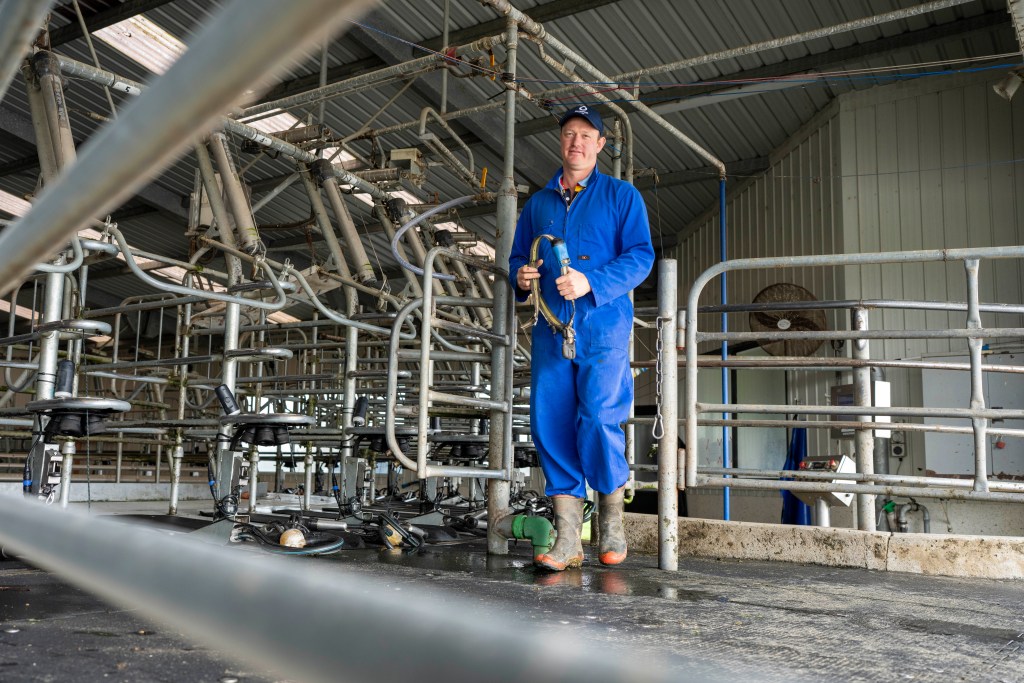
Waikato sharemilkers Clare and Nic Coppard are firm believers in the power of data to improve cow performance and provide better work-life balance for themselves and their farm staff.
The couple are coming into their sixth season as 50-50 sharemilkers on Marg and Terry Troughton’s 206ha (190ha effective) dairy farm 10 minutes from Matamata in central Waikato. They were among a group of early adopters of cow wearable technologies when they purchased a full herd set of SenseHub Dairy collars in September 2022.
After recently buying their own bare run-off block near the milking platform, they plan to increase the size of their herd, supported by SenseHub Dairy collars and recently installed in-shed sensors to check the somatic cell count of each cow as it is milked. “We were milking 600 cows when we took on the sharemilking position here, but we’re increasing the herd size to 640-650 cows,” Nic says.
The new run-off block means rather than holding their replacement heifer calves on the milking platform through to May each year, they will be moved straight there after weaning off milk.
“Having those calves on the milking platform takes up about 12-15ha over summer, so if we can replace them with three cows per hectare, that’s where we will get the lift from.”
Pasture production each year ranges from a low of 11 tonnes/ha up to a peak of 17 tonnes/ha, depending on the weather, and harvesting a high proportion of feed grown on the farm is always their goal. They recently purchased a mixing wagon and Marg and Terry have constructed a concrete storage pad to reduce wastage and provide the option of feeding part stacks of maize or grass silage. They grow about 17ha of maize each year on the milking platform which typically yields 25-28 tonnes/ha of silage, or about 460 tonnes total production. This will usually be fed from March through till November. Nic has bought another 125 tonnes to ensure he has sufficient maize on hand for later in spring once the maize grown on-farm finishes.
“Now we have the concrete pad, we can multiple different stacks, accessed from both ends of each stack giving us more flexibility”
Over a typical season, they also expect to feed about 250 tonnes of palm kernel, 130 tonnes of Golden Dried Distillers Grain (GDDG) and 30 tonnes of molasses which is mixed and fed from the new mixing wagon. Production over the past four seasons has ranged from 236,000 to 245,000kg milk solids, averaging close to their goal of 240,000kg.
Until the 2025-26 season, Nic says about a quarter of the herd was milked once each day, all season.
“Around Christmas time, we would push that out to about a third of the cows being milked once a day, particularly the younger cows and heifers. We were just wanting to look after them a little more.”
But this season’s production (2025-26) was just over 260,000kg after a change in strategy.
“A lot of that extra production was gained last spring when we milked everything twice a day and then we put part of the herd on once a day from the middle of December.”
Nic says he was concerned about the impact on mating from milking the full herd twice a day.
“But with the mixer wagon, we’re getting a better distribution of minerals than the silage wagon and we can put molasses in to give them extra energy.”
The SenseHub Dairy collars really come into their own in the period before and after calving as each cow transitions to its next phase of milking for the season. To guide each cow’s transition, Nic still uses the original report set up by their SenseHub Dairy trainer when the collars were installed in his first season.
“We milk everything once a day as a colostrum cow and then after four or five days they are moved to another once-a-day mob. Once they’re ruminating at our pre-set minimum level (450 minutes/day), that’s when they are drafted into our twice-a-day milking mob,” he says. It’s not a ‘mob’ decision, Nic says. It’s an individual cow decision, thanks to the power of the SenseHub Dairy collar data.
“We’re waiting till they’re eating well enough. For some cows, it’s straight away and they’re fine, but for others, it might take a couple weeks.”
“Because we’ve got individual rumination data from those cows, so we can make that call.”
At each morning milking through calving, Nic’s focus is on checking the cows that have been automatically drafted out of the colostrum or initial once-a-day mobs, based on their rumination level.
“I’m not putting cups on cows which is where you often pick up health issues, so this is where the collars are hugely beneficial for keeping track of general animal health, as well as all the heat detection side.”
“We probably caught five or so pneumonia cows that we would have caught when they started looking really sick, but we’ve caught them in time to treat them, so they’ve carried on milking and they’re fine.”
Mating begins on October 5 and ends about December 20. The whole herd is artificially inseminated and there are no natural matings or follow-up bulls used. “We were using all AB for three years before we had the collars too, and that meant a very long period of time for me watching cows all the time,” he says.
Nic has full confidence in the data generated by each cow collar to signal it is on heat and for the Protrack system to automatically draft them off for insemination. “We were very lucky the Protrack drafting gate was already here on the farm and the SenseHub Dairy collars just link together with it for automatic drafting.”
The herd is mostly Friesian-Jersey cross. Nic’s policy is to use some sexed straws for the first 21 days of mating to ensure he has sufficient replacement heifers. “Any other good cows after that first period of mating get ‘Forward’ Pack semen from Livestock Improvement Corporation Limited. I’ll also be mating the bottom 30% of cows to Charolais semen from day one. And then from day 22 onwards, Charolais for pretty much all the bigger cows and short gestation crossbreed for all the smaller cows from day 22.”
This policy means all the replacements come from the first three to four weeks of calving. “We can pregnancy scan the cows and usually get 99% of them matched to the semen they’re actually in calf to,” he says.
Nic splits the herd into two calving mobs – one carrying replacements and the other carrying all the short-gestation and beef-sired calves. “It means I can send staff or go myself to a paddock with either mob and know that all the calves we pick up are either all replacements that go to our replacement shed, or they are not replacements so they go to another shed.”
DNA testing is used to confirm replacement parentage. Their herd’s six-week in-calf rate was 71% last spring, down a little on their usual range of 71-74%. Empty rate at pregnancy testing in the autumn this year was 13%. In the past couple of years, Nic has also put CIDRs into between 5-10 cows that he wanted to retain in the herd. Heat detection is accurate and simple, for the whole team, thanks to the collar data. “With full integration in place with MINDA, our SenseHub DataFlow software sorts the cows that need to be drafted for artificial insemination straight to Protrack. Then, once the technician’s done their thing, it all just gets sent through to MINDA and the collar system to say that she has had a mating,” he says.
In September last year, SenseHub Dairy Somatic Cell Count (SCC) sensors were installed in half of the stalls in their rotary milking shed as part of a wider trial to test their effectiveness in a large-scale dairy farm. The trial showed the new sensors were very successful at detecting the presence of mastitis so with Marg and Terry’s support, they decided to keep the technology in the shed and purchased the trial sensors that were in half of the stalls.
“Instead of relying on a herd test SCC result that could be two weeks old by the time we need to use that data, I can look at the SCC data the same day it’s collected and make a call about treating a cow or drying her off.”
Nic says with daily SCC data available, he can look at trends for individual cows before making a call.
“It’s amazing when you’re seeing their cell count most days how much it can jump up and down with no clinical infection showing”.
“You’ll strip them for days and you’ll never see a clinical sign, but the sensors are great at picking it up early,” he says.
He is pleased their herd is holding its lowest cell count since being on the farm, at 156,000 on average, and is also anticipating using more anti-inflammatory treatments rather than treating high SCC cows with antibiotics. Having looked at the other wearable options since the SenseHub collars were installed, Nic is confident they are the best cow monitoring system available.
“They definitely make our life easier. Just being able to keep an eye on things without having to be hands-on 100% of the time is the big thing for us as a family,” he says.
“And when you go on holiday, there’s an app on my phone for health and mating from the collars. With DataFlow installed, I can jump on and screen share with the cowshed computer while away, and have a look at what the data is showing, including the somatic cell count data”.
“I just say to the guys on milking, I’ve put a draft in for a cow, can you check it’s mastitis or not.”
Before installing the SenseHub Dairy collars, Nic was fully committed every day through calving then mating, at best getting a four or five-day break between. He admits he initially took a few weeks to build confidence in the heat detection capability of the collars, before rostering himself for late starts through the remaining mating period.
“Having regular sleep-ins doesn’t just benefit me, it benefits our family, our team of staff,” he says.
Having the backing of global animal health giant MSD Animal Health, means there is plenty of development investment going into them. Nic says the back-up service from the SenseHub Dairy team is superb. The few issues he’s encountered are usually sorted with a phone call or intervention from one of the support staff through an online connection to the farm’s computer system.
“We had regular trainings for the first couple years, but you can ring the help desk at 4am, talk to someone who knows what they are doing and can sort out the problem,” he says.
Some of the early collars they fitted on cows in their herd are nearing the end of their battery life and are being replaced.
After a good financial year in 2022, the Coppards opted to buy the collars to take advantage of the hefty depreciation opportunity for tax purposes, rather than go for the monthly subscription model which is popular these days.
“I suppose we’ll have to make that call if we just follow the subscription model in the future, but we had the money at that time to do it and that means we haven’t had to pay anything for the past four or five years.”
One of the mid-winter jobs is to ‘collar’ the incoming replacement heifers. While not one of Nic’s favourite jobs, it is completed by the team in the race at the shed in a morning. The cows adjust quickly to having the collars on, and he hasn’t noticed any rashes or rubbing around their necks. Although it’s not a priority at this stage, Nic is interested in the new SenseHub Dairy inline milk quality sensor which is now available.
sign up or have a chat – leave your details below
Our local Sales Specialist will get in touch soon.
NZ-SHB-260600032

 Algeria
 Argentina
 Australia
 Belgium (Dutch)
 Brazil
 Chile
Chile China
China Colombia
 Czech Republic
 Egypt
Egypt Finland
 France
 Germany
 Ireland
 Italy
Italy Japan
Japan Libya (Arabic)
 Mexico
 Morocco
 Netherlands (Dutch)
 New Zealand
 Norway
 Panama
 Poland
 Portugal
 Saudi Arabia (Arabic)
 Spain
Spain Sudan (Arabic)
 Sweden
 Tunisia
 Turkey
 United Kingdom
 Vietnam
 Global